
Human-Centered Research in an AI-Driven World
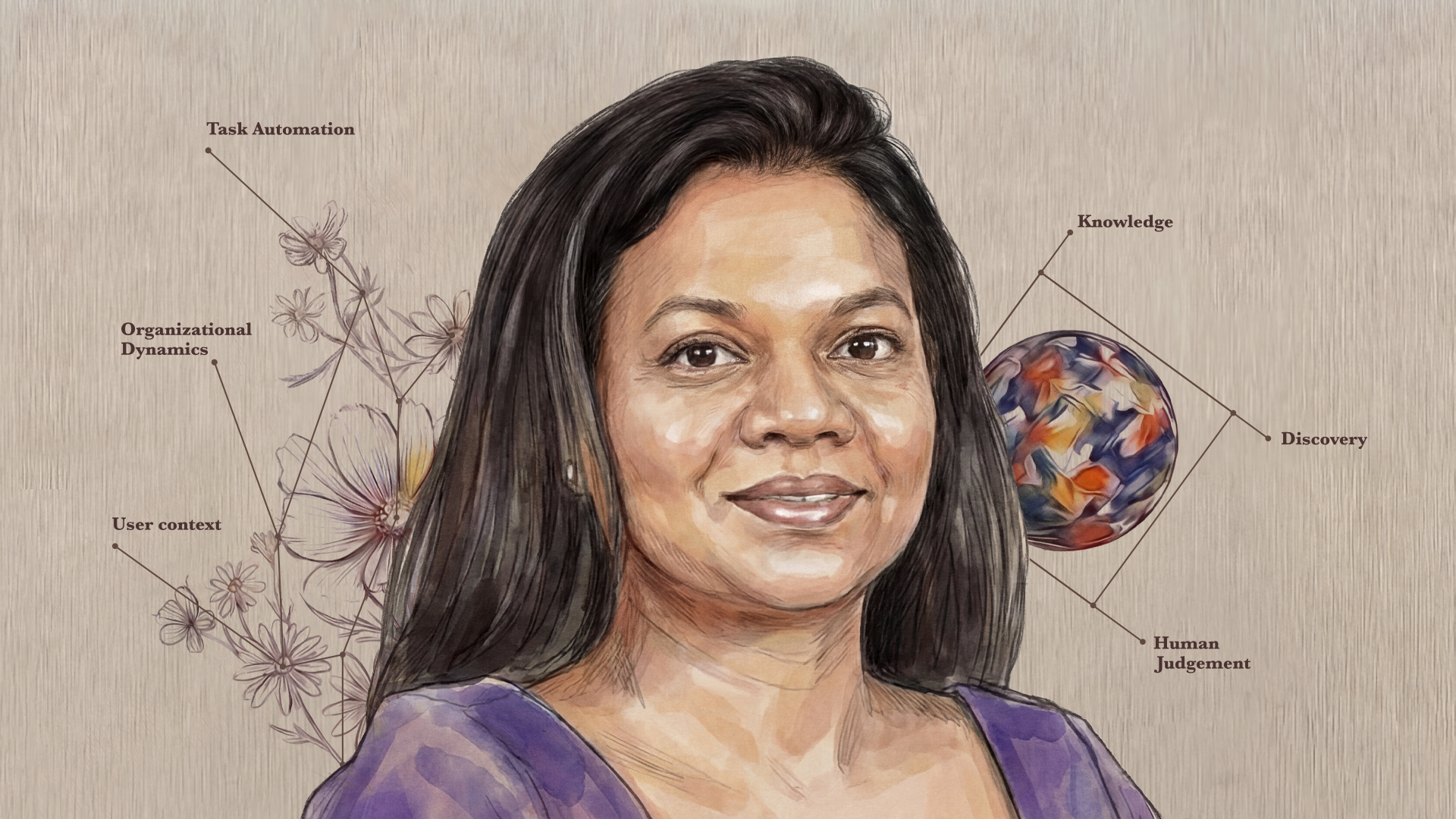
Welcome to another installment of Think First: Perspectives on Research with AI. Last time we heard from Jeremy Williams who shared how he uses AI as a pragmatic research assistant—broadening perspective, speeding analysis, and troubleshooting code while keeping human judgment firmly at the center. Today, we’re hearing from Utpala Wandhare, a seasoned UX design and research leader with over 20 years of experience spanning B2B, B2C, and startup environments in India.
Utpala currently leads design and research for a data and AI business vertical at GlaxoSmithKline (GSK), where she brings a rich perspective shaped by roles at organizations like Honeywell, Bosch, and Microsoft. With a foundation in ethnographic research and a passion for integrating technology into practice, Utpala’s recent focus has been adopting AI tools to enhance productivity, streamline research processes, and foster cross-functional collaboration. Her approach centers on leveraging AI for automation and knowledge discovery while maintaining a strong commitment to human-centered research and organizational impact.
From automation to augmentation: Utpala’s AI origin story
Utpala’s journey with AI began with a focus on automation. Early in her career, as an ethnographic researcher working with Nokia to understand emerging markets, she saw the potential for AI to delegate manual tasks and improve efficiency.
“My earliest memory of AI for research is around automation…Research can be so extensive and intense—planning, execution, data collection, analysis, reporting. How do you delegate some of these manual tasks and automate them?”
For Utpala and her team, the early adoption of AI focused on tasks like transcription, translation, generating images or graphs, and composing sentences.
The early adoption of AI within my team was starting with transcriptions and translations, because we do interviews in multi-language as well. I would call these micro-tasks—the small tasks that AI can really help with.
Over time, her use of AI evolved from simple automation to more advanced knowledge work, leveraging Microsoft 365 Copilot, GitHub Copilot, Perplexity, and internally-built AI tools.
“It really started with automation, but more recently, AI has completely changed the productivity landscape for knowledge workers, going beyond automation. It is still evolving and I think we are in a very early stage right now.”
Practical impact: Where AI delivers value
As AI tools matured, Utpala’s team began using internal applications to summarize product requirements, search past research, and avoid duplicating work. This shift has improved collaboration and increased the speed of delivering user research, especially in decentralized teams where knowledge is scattered.
“We upload product requirement documents and create a summary we can use to write our research proposals. I’ve started also using this internal AI tool to look through some of the old research studies that have been done. Unfortunately, we do not have a centralized repository. It’s a decentralized team. So, research studies are lying around here and there. The old system was to ping somebody and say, ‘do you have so and so study or personas?’ But today, I use this internal AI application to find some of this information. It really helps speed up the process.”
Utpala also emphasizes that the value of AI isn’t limited to efficiency gains—it can help teams synthesize context across users, organizations, and prior studies to move faster from scattered inputs to coherent experience narratives.
“AI can really help in using research findings and insights from different studies combined and for first cut of customer journeys and design concepts. AI helps us accelerate and create a seamless and cohesive user experience.”
At this point, Utpala uses AI to augment all stages of the research process, from planning (generating study plans, interview guides, and screeners), to conducting interviews (AI notetaking, identifying patterns and pain points in real time), and analysis (transcribing, translating, and summarizing individual interviews).
“When we look at all of these scenarios of conducting user research, as well as partnering with our cross-functional teams, a lot of these are really dependent on productivity and efficiency. There are certain use cases where AI can really help. Applying intelligence with input of the research objective, AI can help in activities like grouping, sorting, clustering, coding, and identifying the users’ quotes, patterns, and then deriving insights and themes.”
Navigating challenges and building trust
But even as she embraces AI for planning and analysis, Utpala is clear about where the technology still falls short. The most essential parts of moderating interviews—reading body language, sensing hesitation, and building genuine rapport—are deeply human skills that she believes AI is far from replicating. Like Rodrigo Dalcin, she draws a firm line when it comes to AI-moderated research.
“When I look at my work, when we sit down and conduct these interviews, we really know how to moderate, because we are paying attention to so many different things. It’s not just what they’re saying, but we are observing. We’re looking at body language, right? Even over a video call, there’s so much connection that you have with that human being. That’s the concern I have…Can we really completely depend on an AI technology to interact with a human? I don’t see me doing that.”
Even with clear productivity gains, Utpala describes the current moment as transitional—marked by uneven adoption, fragmented knowledge, and an open question about whether AI can be trusted for nuanced judgment in complex, high-stakes research. In her view, trust is the hardest hurdle to clear.
This is still very early stages, right? We haven’t fully adopted some of these things. As a researcher, I still go back to my handwritten notes, I still have that connection. I think the major challenge I see is about trusting AI. Our users are not general consumers, we are in a space where we are looking at extremely complex systems, very sophisticated problem statements…my users who are clinical scientists, they work on a lot of computational modeling, proactive and predictive analysis. Can they trust the technology to do that?
For Utpala, AI is best used for first drafts and data analysis, but final insights and decisions still require human collaboration and judgment. Like Chelsey Fleming, Utpala believes that humans should be driving these activities.
“What I really see it as is the first cut or the first draft that I really want to get from AI, and not really the final report or the final insight, because that I still feel requires different people to come together. It’s not about delegating that task to AI. I really want my team to be participating in that.”
Looking ahead: The future of research with AI
Utpala is optimistic about AI’s potential to transform research, but she believes the human element will remain essential.
“I think we can only speculate, and I’m very positive about how AI is going to impact us in a very positive way. It’s really going to help us. It’s going to assist us. It has started to do that today…But I don’t see human going away from the loop.”
She envisions a future where AI automates routine tasks, freeing researchers to focus on higher-order thinking, creativity, and collaboration. At the end of the day, Utpala’s approach to research remains fundamentally human-centered.
“It is really centered around a person or a human or a user, right? That’s the key thing.”
Advice for teams and final thoughts
Utpala encourages research teams to use AI as a connective layer across the organization—pulling together inputs from user research, analytics, customer feedback, and social listening so teams can triangulate findings across methods and share knowledge more effectively.
“We do a lot of data triangulation. It’s not just the user research team, but also the data analytics team, customer feedback team, and social media. There’s a bunch of data lying there. How do we bring all of this data together?
AI can significantly improve the outcome by reading through all the different sources of data, types of data from multiple methods used like surveys, observations, interviews, behavioral data and analytics, triangulating and deriving findings and insights
Utpala’s experience illustrates how AI is steadily reshaping UX research—not by replacing human expertise, but by streamlining routine tasks and surfacing valuable knowledge. While she sees clear benefits in productivity and collaboration, she remains pragmatic about the limitations and the need for trust in complex environments. Ultimately, Utpala’s perspective is that AI should be viewed as a practical tool that enables researchers to focus on deeper analysis and creative problem-solving, with the human element remaining central to meaningful impact.
Next week, Zack Bodnar takes us inside his AI-augmented research workflow at Red Hat, where he shares what it looks like to redesign the entire research system around experimentation, agentic tooling, and rigorous evaluation. Don’t miss his unique perspective in our ongoing series!